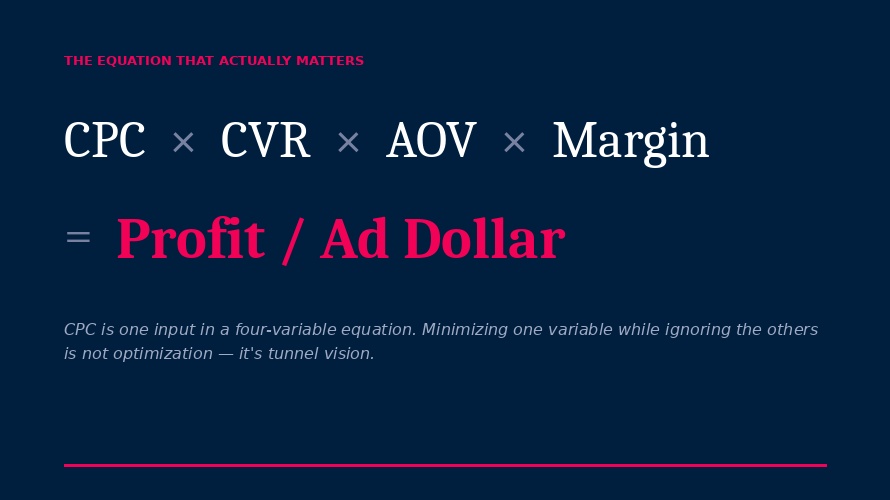
Optimizing for low CPC is like judging a sales rep by call volume instead of closed deals. Activity is not outcome. A sophisticated paid search program doesn't minimize CPC — it maximizes return on every dollar of ad spend.
| 01 | Conversion rate determines actual acquisition costA $2 CPC converting at 0.5% costs $400 per acquisition. A $4 CPC converting at 3% costs $133. Lower CPC, dramatically worse outcome. CPA — not CPC — is the minimum threshold for any meaningful efficiency comparison. |
| 02 | AOV and margin determine whether acquisition cost is good or badA $100 CPA on a $120 product is a disaster. The same $100 CPA on a $400 high-margin product is excellent. CPA without margin context is meaningless. The optimization target is profit per ad dollar — and that requires holding the full funnel simultaneously. |
| 03 | Not all clicks are equal — intent matters more than costPerformance Max generates high click volume at low CPCs by serving in low-intent placements: display, YouTube, search partners. These clicks look efficient in a CPC report and convert poorly or not at all. Cheap clicks from the wrong audience are worse than expensive clicks from in-market buyers. |
| 04 | Budget exhaustion creates artificially low CPCsWhen campaigns hit daily budget caps and go dark mid-day, average CPC looks low because you're only competing in cheaper early-morning auctions. You're not capturing efficient traffic — you're absent from the afternoon auctions entirely. Low CPC in this scenario is a symptom of underinvestment, not efficiency. |
| 05 | CPCs are an auction outcome, not a controllable inputIn high-spend months and competitive categories, CPCs rise because more advertisers are bidding. A higher CPC during a peak season with strong conversion volume is expected and appropriate. Comparing CPC across different time periods or categories without controlling for market conditions is not an apples-to-apples comparison. |
“CPC is an input. We optimize for profit per ad dollar, which requires holding the full funnel simultaneously. That is not a choice — it is the definition of a sophisticated paid search program.”
Rather than did CPC go up or down, the analytically sound question is: for every dollar we spent, how much profit did we generate, and are we reaching more of our addressable market than before? Those are the questions a real measurement infrastructure is built to answer.